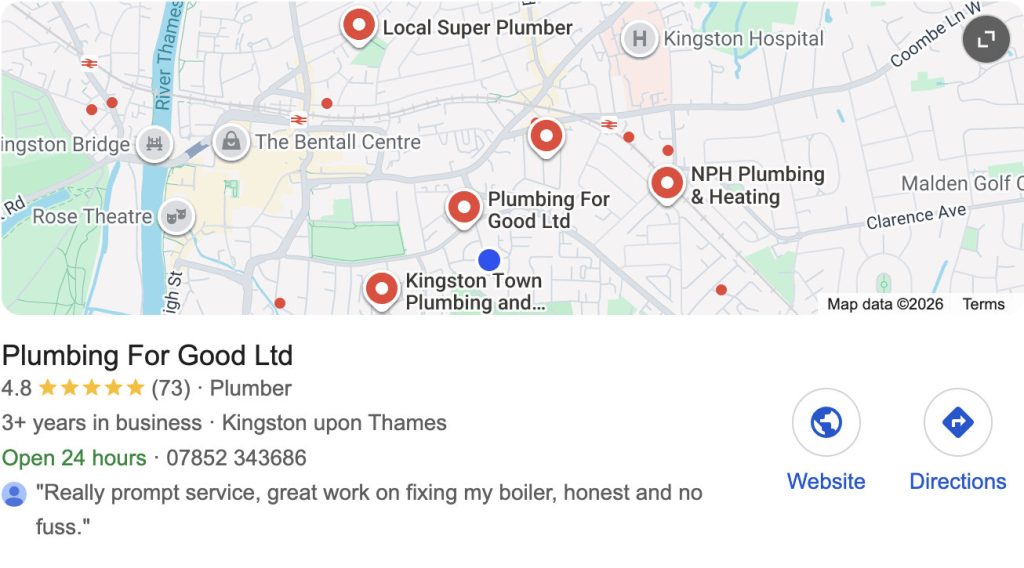
You have a good business in Kingston. You do quality work. Your customers are happy. But when someone in Kingston searches for what you do, your business doesn’t show up in those map results at the top of Google.
Your competitors do. You don’t.
That’s the Google Local 3-Pack. Those three businesses with the map pins that show up before the regular search results. And if you’re not in it, you’re invisible to most local customers.
I’m going to explain exactly why you’re not showing up and what needs to change. This isn’t complicated theory. These are the actual problems I can fix, based on what’s working in local SEO in 2026.
What Is the Google Local 3-Pack (And Why It Matters More Than Ever)
The Local 3-Pack is those three business listings that appear with a map when someone searches for a local service. Search “psychologist Kingston” or “web designer Surrey” or “kitchen fitters near me” and you’ll see them.
Those three businesses get most of the clicks. The rest get what’s left.
Why this matters in 2026:
- 46% of all Google searches are looking for local information
- 76% of people who search for something nearby visit a business within 24 hours
- Google’s AI now pulls from these listings for direct answers
- If you’re not in the 3-Pack, you’re fighting for scraps
I had a client, a psychology clinic, who moved from Kingston to Surbiton. Same quality service. Same therapists. But enquiries dropped substantially. Why? Because she wasn’t showing up in Surbiton searches anymore. She was still ranking well in Kingston, but that didn’t help her new location.
We optimised her website for Surbiton, added service pages mentioning the area, created location-specific content. Now she ranks top of the map pack for multiple search terms in Surbiton. Her enquiries increased. Her website visits increased. She’s visible again.
That’s what proper local search optimisation does.
The Real Reasons You’re Not Showing Up in the Google Local 3-Pack
When I look at why Kingston businesses aren’t ranking locally, it’s usually the same problems. None of them are mysterious. All of them are fixable.
According to the 2026 Local Search Ranking Factors report from industry experts, Google Business Profile signals account for about 32% of local pack rankings. Your website’s on-page SEO accounts for another significant portion. But here’s what most businesses get wrong.

1. Your Google Business Profile Isn’t Set Up Properly
Your Google Business Profile is the foundation. If this isn’t right, nothing else matters. In 2026, eight of the top ten ranking factors come directly from your GBP.
Common problems I see:
- Wrong primary business category selected (this is the single biggest GBP ranking factor)
- Incomplete business description with no local keywords
- Missing or wrong service areas defined
- Few or no customer reviews
- No regular posts or photo updates
- Inconsistent business name across listings
The primary category you choose carries the most weight. If you’re a web designer and you’ve selected “Marketing Agency” instead of “Website Designer”, you’re not going to rank for web design searches. You can manage your categories and other settings in Google Business Profile Manager. It sounds obvious, but I see this constantly.
Your GBP needs to look active. Businesses that post weekly updates, respond to reviews, and add new photos consistently outperform inactive profiles. One landscaping client saw a 21% increase in local search visibility after three months of weekly GBP posts.
2. Your NAP Is Inconsistent Across the Web
NAP stands for Name, Address, Phone number. Google uses NAP citations as proof your business information is accurate. If your details are different on different sites, Google loses confidence in your listing.
What inconsistent NAP looks like:
- Website says “Kingston upon Thames” but GBP says “Kingston”
- Phone number formatted differently on various directories (020 8123 4567 vs 02081234567)
- Business name varies slightly (Design by Nadja vs Nadja Design vs Design By Nadja Ltd)
- Old address still showing on some directories
It’s absolutely critical that your NAP is 100% identical everywhere it appears. I had a client who wasn’t ranking because their old address from three years ago was still listed on 12 different directories. Once we updated those, their rankings improved within weeks.
3. You’re Not Listed in Key UK Business Directories
Directory citations might only account for 6-7% of ranking factors in 2026, but they’re still essential. They prove your business is legitimate and support trust signals for Google’s AI.
UK directories that matter:
- Yell.com (the granddaddy, still relevant)
- Thomson Local (recently modernised, strong local focus)
- Scoot (automatically distributes to other directories)
- Freeindex (ranks well with Google quickly)
- Your local council business directory
- Industry-specific directories relevant to your sector
The key is ensuring your NAP is consistent across all of them. One standard format everywhere. No variations.
Don’t waste time on hundreds of directories. Focus on 10-15 quality ones with high domain authority and ensure your information is identical on each.
4. Your Website Has No Proper Location Pages
You can’t just mention Kingston once on your homepage and expect to rank. Google needs clear signals about where you operate and what you do there.
What’s usually missing:
- Dedicated service area pages (Kingston, Surbiton, Richmond, etc.)
- Service pages that mention local areas naturally
- Location-specific content that isn’t just keyword stuffing
- Internal links between location and service pages
- Local schema markup telling Google what your business is
My psychology clinic client didn’t just add “Surbiton” to her homepage. We created proper service pages, location content, FAQ sections answering local questions, and structured it so Google understood she serves Surbiton with specific psychology services. That’s why she ranks.
For service-area businesses, individual city pages outperform generic “we serve the area” statements. An HVAC contractor targeting multiple towns gained top-3 map positions after adding localised content and schema markup for each location.
5. You Haven’t Done Basic Keyword Research
Most businesses put content on their website that they think makes sense. But they haven’t checked what people actually search for.
The problem:
- You call it “therapeutic counselling” but people search for “therapist near me”
- You use industry jargon instead of terms customers use
- You focus on what you do instead of what people need
- You haven’t checked if people add “Kingston” to their searches or just search locally
I don’t do complex keyword research campaigns. I’m not an SEO agency. But I do research the 5-10 main terms your local customers actually use and optimise your content around those. That’s what gets you found.
In 2026, Google’s AI is also pulling from this content to generate direct answers. If your content clearly answers local questions, you’re more likely to appear in AI Overviews, which is becoming a critical visibility factor.
6. Your Website Structure Is Wrong for Local Search
Google needs to understand what you do and where you do it. Most websites don’t make this clear.
What’s missing:
- Schema markup (code that tells Google what your business is and where you operate)
- Proper heading structure with location keywords used naturally
- FAQ sections answering questions locals actually ask
- Clear service descriptions with location context
- Contact page with NAP matching your GBP exactly
- Embedded Google Map showing your location
These aren’t complicated. But if they’re not there, you’re not ranking. Schema markup might sound technical, but it’s straightforward to implement and it directly helps Google understand your business.
7. You Have No Strategy for Reviews
Reviews matter more than ever. In 2026, review signals are a primary ranking factor. Businesses with more positive reviews rank higher in the Google Local 3-Pack.
What Google looks at:
- Number of reviews (more is better)
- Average star rating (aim for 4.5+)
- Review frequency (regular new reviews, not just one burst)
- Review responses, especially from the owner
- Keywords naturally mentioned in reviews
A client with 150 five-star reviews slipped in rankings after six months without new feedback. When they restarted review requests and gained ten new reviews in two weeks, their map position rebounded within days. Fresh activity signals trust to Google.
I help clients set up their Google Business Profile to encourage reviews. Then they actually get enquiries because people trust businesses with real, recent reviews from real customers.
8. Your Website Isn’t Optimised for Local On-Page SEO
Your website’s on-page content still plays a huge role. On-page signals account for about one-third of organic local ranking factors.
What needs to be right:
- Title tags with city + service keywords (naturally, not stuffed)
- H1 and H2 headers mentioning location where relevant
- Meta descriptions that include your area
- Dedicated location pages with unique, helpful content
- Alt text on images describing both the image and location context
- Internal links connecting related local and service pages
This isn’t about cramming “Kingston” into every sentence. It’s about naturally structured content that makes it clear where you operate and what you offer there.
Can You Fix This Yourself?
Honestly? You could. You could do courses. Learn local SEO. Study schema markup. Research keywords. Optimise your Google Business Profile. Structure your website properly. Set up NAP consistency across directories. Get the technical details right.
I could also do my own wedding flowers if I did a course.
The question isn’t “can you do it?” The question is “do you want to spend your time learning local SEO instead of running your business?”
Some bits are simple. You can definitely improve your Google Business Profile yourself. You can make sure your NAP is consistent. You can ask customers for reviews. You can claim your business on major UK directories.
But to get most of it right – the website structure, schema markup, keyword research, proper service and location pages, internal linking strategy, FAQ optimisation, directory management – that’s a lot. And if you get it wrong, you’re still not showing up.
What Actually Needs to Happen
Here’s what I do for Kingston businesses who want to show up locally.
During the website build:
- Structure pages properly for local search from the start
- Add schema markup so Google understands your business and location
- Research the 5-10 main keyword phrases your customers actually use
- Create service pages optimised for those terms with natural location mentions
- Add location pages if you serve multiple areas (Kingston, Surbiton, Richmond, etc.)
- Set up internal linking between relevant pages
- Write FAQ sections that answer the questions locals search for
- Ensure your NAP is consistent throughout the site
Google Business Profile setup:
- Create or optimise your profile properly (if not already done)
- Choose the most specific primary category
- Write a clear business description with relevant local keywords
- Add correct service areas and business details
- Set up review requests and response strategy
- Make sure everything matches your website exactly
Directory citations (if needed):
- Claim or create listings on key UK directories
- Ensure NAP is identical across all platforms
- Update or remove old, incorrect listings
- Focus on quality directories, not hundreds of low-value ones
After launch:
- You manage your Google Business Profile with regular posts and photos
- You ask customers for reviews and respond to them
- You update your own content when needed
- I handle technical updates, monitoring, and maintenance
This isn’t ongoing SEO management. I’m not running monthly campaigns or building links or creating content calendars. I build your website properly structured for local search and set up your foundational citations. Then you’re set up to be found.
The Kingston Context
Kingston is part of London. It’s densely populated. There’s real competition for local search terms. That means you can’t half-do this.
But it also means there are plenty of potential customers searching right now. People looking for what you offer in Kingston, Surbiton, Richmond, New Malden, and surrounding areas.
If you show up when they search, you get enquiries. If you don’t, your competitors do. It’s that simple.
What I Don’t Do
I need to be clear about this because I’ve seen too many web designers overpromise on SEO.
I don’t offer:
- Ongoing monthly SEO campaigns
- Link building services
- Monthly ranking reports
- Detailed competitor analysis
- Google Ads or PPC management
- Social media marketing
- Content creation calendars
- Managing your Google Business Profile for you ongoing
I’m not an SEO agency. I’m a web designer who specialises in local business websites. I build websites that are properly structured for local search, with the right technical foundation, proper schema markup, and optimised content. I also set up your Google Business Profile correctly and ensure your NAP is consistent across key directories.
Most web designers don’t do this. They build a nice-looking site and that’s it. I build sites that are found.
If you need a full SEO agency running monthly campaigns, that’s not me. But if you need a professional website built right for local search from day one, with someone who understands local ranking factors and sticks around to support you, that’s exactly what I do.